
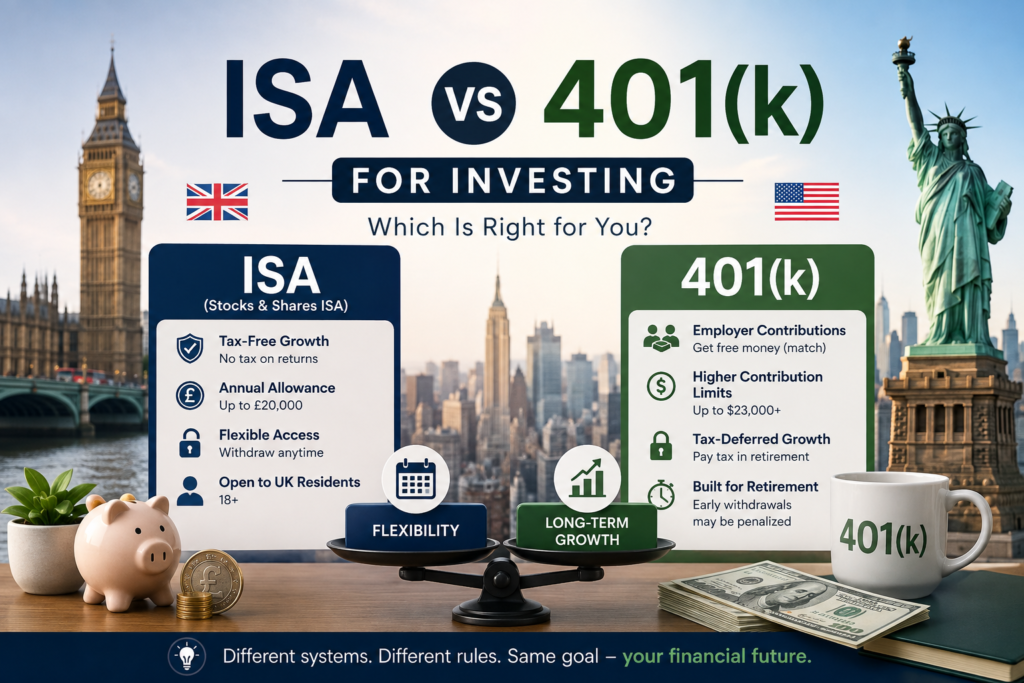

A friend of mine in London and her cousin in New York both started “investing” the same month last year. They compared notes over a video call and quickly realised they weren’t even talking about the same kind of account. One was maxing out something called an ISA, the other was putting money into a 401(k) through work, and neither could quite explain the other’s system. If you’ve ever found yourself in a similar conversation, this ISA vs 401k for investing comparison is for you. Whether you’re based in the UK, the US, or just trying to make sense of both, here’s the plain-English breakdown.
First Things First: What Even Is a Stocks and Shares ISA?
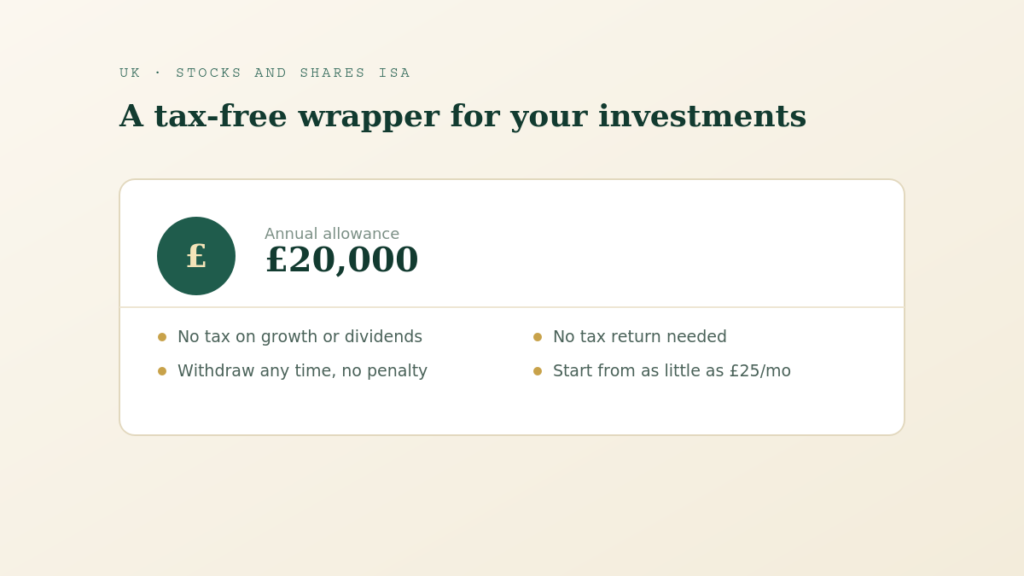
A friend of mine in London and her cousin in New York both started “investing” the same month last year. When it comes to ISA vs 401k for investing, the UK side starts here: at ThePennyfy, a Stocks and Shares ISA is what we point UK readers toward first, since it shields your money from tax. You can put in up to £20,000 a year, and whatever it earns (growth, dividends, interest) stays completely untouched by HMRC, with no tax return needed. Anyone over 18 and UK-resident can open one, and most providers let you start with far less than the full allowance, some accept as little as £25 a month..
And What’s the Deal With a 401(k)?
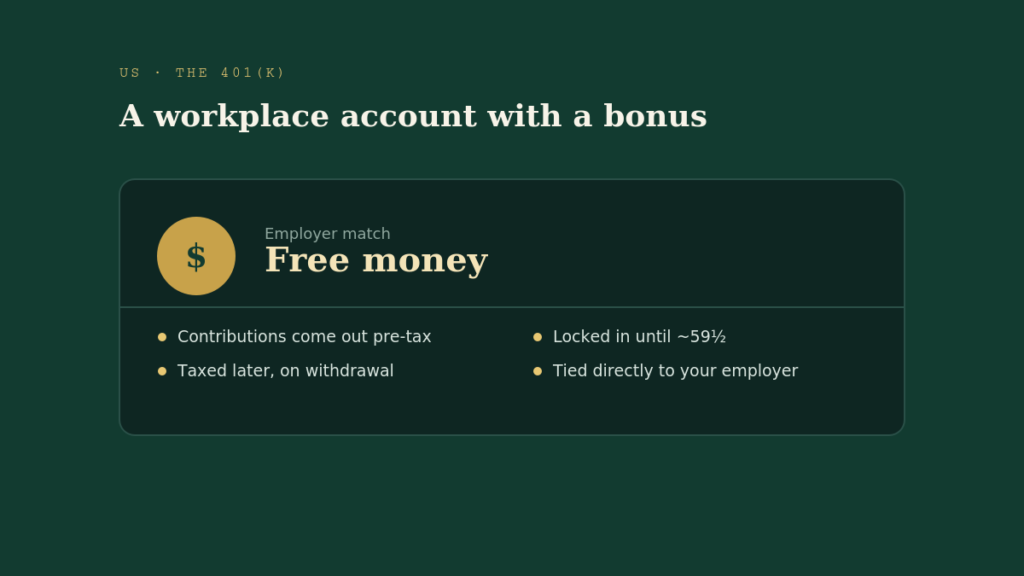
On the other side of ISA vs 401k for investing, across the Atlantic, the 401(k) plays a similar role but works quite differently. It’s a retirement account offered through an employer, and contributions usually come straight out of your paycheck before tax. Many employers also match a portion of what you put in, which is essentially free money, assuming you contribute enough to claim the full match. The trade-off is access: money in a 401(k) is meant to stay there until retirement age, and pulling it out early usually triggers a penalty on top of the tax owed. It’s less flexible than an ISA, but that structure is part of what makes it effective for long-term investing.
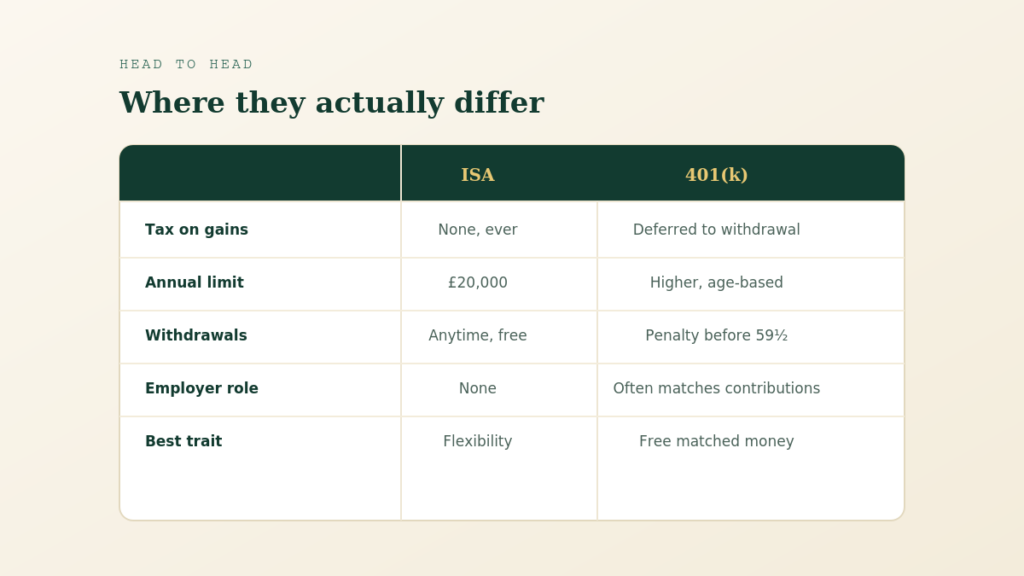
ISA vs 401k for Investing: Where They Actually Differ
Who Gets Taxed, and When
An ISA is essentially taxed never: you pay income tax on the money before it goes in, then nothing further touches it. A 401(k) flips that: contributions typically go in pre-tax, lowering your taxable income now, but withdrawals in retirement get taxed as regular income. Both approaches to investing save you money over time, just at different points in the timeline.
How Much You Can Actually Put In
UK savers get £20,000 a year to work with inside an ISA. US savers contributing to a 401(k) get a considerably higher limit, into the low tens of thousands annually, though it depends on age and whether catch-up contributions apply. Neither limit is small, but the 401(k) ceiling tends to be higher in raw terms.
Getting Your Money Out: It’s Not the Same Story
This is where the two genuinely part ways. An ISA lets you withdraw whenever you like, for any reason, with zero penalty. A 401(k) is far stricter: take money out before around age 59½ and you’re typically looking at a tax bill plus an extra penalty on top. One account is built for flexibility, the other for discipline.
Does Your Employer Have Skin in the Game?
With an ISA, your employer has no involvement whatsoever, since it’s entirely a personal account you manage yourself. A 401(k), by contrast, is usually tied directly to your job, and employer matching is often the single best reason to prioritise it. Turning down a match is effectively turning down part of your salary.
ISA vs 401k for Investing: Which One’s Actually Right for You?
If you’re in the UK, the Stocks and Shares ISA is generally the sensible starting point, since it’s flexible, tax-free, and doesn’t lock your money away. If you’re in the US and your employer offers any kind of match on a 401(k), contributing at least enough to capture that match is usually worth doing before anything else, simply because the free money is hard to beat. For anyone splitting time between both countries, or holding dual status, the honest answer is that this gets genuinely complicated: cross-border tax rules around ISAs and 401(k)s don’t always play nicely together, and that’s a conversation worth having with a tax adviser familiar with both systems rather than guessing.
ISA vs 401k for Investing: Mistakes That Quietly Cost People Money
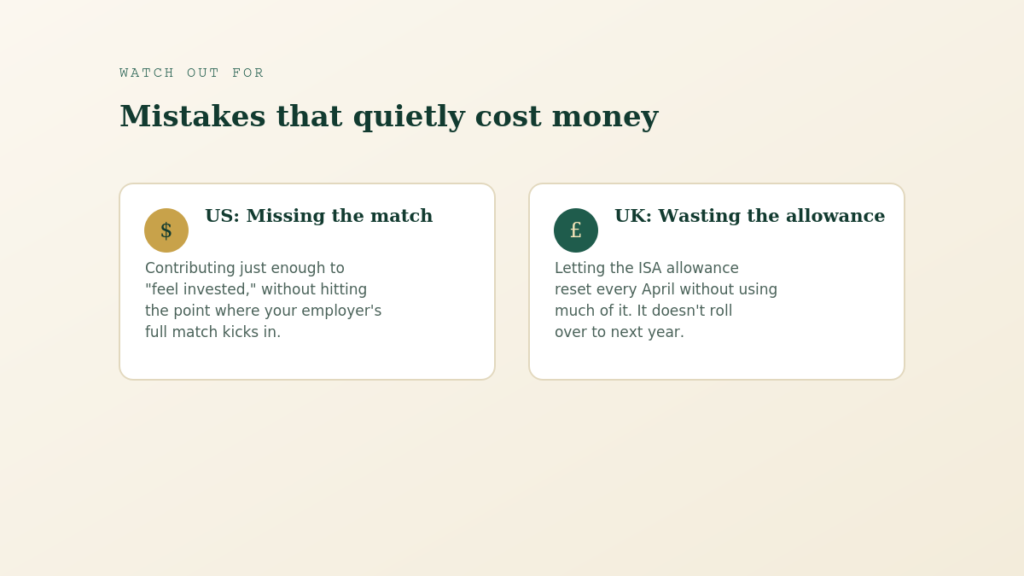
In the US, the most common misstep is contributing just enough to a 401(k) to feel like you’re “doing something,” without actually reaching the point where the employer match kicks in fully, leaving real money on the table every single paycheck. In the UK, the equivalent mistake is letting the ISA allowance reset each April without using much of it, effectively wasting a tax-free opportunity that doesn’t roll over to next year. Both habits are easy to fall into and just as easy to fix once you’re aware they’re happening.
Quick-Fire FAQs
Can I have both a 401(k) and an ISA? For ISA vs 401k for investing purposes, only if you have legal ties to both countries.: a UK resident generally can’t open a 401(k), and a US resident generally can’t open an ISA. Expats and dual residents are the exception, and should get tailored advice.
Which is better for retirement, ISA or 401(k)? When comparing ISA vs 401k for investing, neither is universally ‘better a 401(k) often wins in the US thanks to employer matching, while an ISA wins in the UK for its flexibility. Comparing them outside their own country’s context isn’t really a fair fight.
Is a 401(k) basically just a pension? It functions similarly to one, yes, since it’s a workplace retirement account, though how it’s taxed and accessed differs from a traditional UK pension or SIPP.
What happens if I move countries? Do I lose my account? No, but managing it gets more complicated. A 401(k) generally stays intact if you leave the US, and an ISA stays open if you leave the UK, though contributing further may depend on your residency status.
Can you actually lose money in these accounts? Yes, both are investment accounts, not savings accounts, so the underlying investments can fall in value. The tax treatment is what makes each one attractive, not a guarantee against loss.
The Bottom Line
Strip away the acronyms, and ISA vs 401k for investing really comes down to this: one rewards flexibility, the other rewards patience and employer generosity. Neither is right or wrong: they’re built for different systems, different tax rules, and different stages of life. What matters most is actually using the one available to you, consistently, rather than leaving it half-funded while you weigh up a decision that, for most people, isn’t really a choice at all. At ThePennyfy, that’s the whole point: understanding your options well enough to stop overthinking and just start.