
I used to think investing had a velvet rope around it like you needed a spare few thousand sitting in a drawer before anyone would let you in. My cousin in Manchester thought the same thing. Neither of us had that kind of money lying around. What we did have was £30 a week on her end and $40 a week on mine, and it turned out that was plenty to get through the door.
If you’ve been holding off because you assume there’s a minimum you haven’t hit yet, this is the guide that untangles that assumption. Here at ThePennyfy, we get asked how to start investing with little money more than almost anything else, so we’ve laid out exactly how small a starting amount can genuinely be, where UK and US paths differ, and the traps that catch people in their first few months.
The Minimum Is Smaller Than You Assume
Here’s the part that surprises most people: the typical account minimum at major brokers on either side of the Atlantic now sits at £0 or $0. That wasn’t the case not long ago. Fractional shares changed the arithmetic rather than buying one whole share of a company (which could run into hundreds), you can now claim a sliver of one for as little as a pound or a dollar.
So the question worth asking isn’t “how much do I need before I start.” It’s “how much can I realistically commit to on a repeating basis.” That’s really the heart of learning how to start investing with little money it’s often smaller than people expect.
What Little Money Actually Means Here
Before you can start investing with little money, it helps to define what “little” actually covers. For the purposes of this guide, we mean:
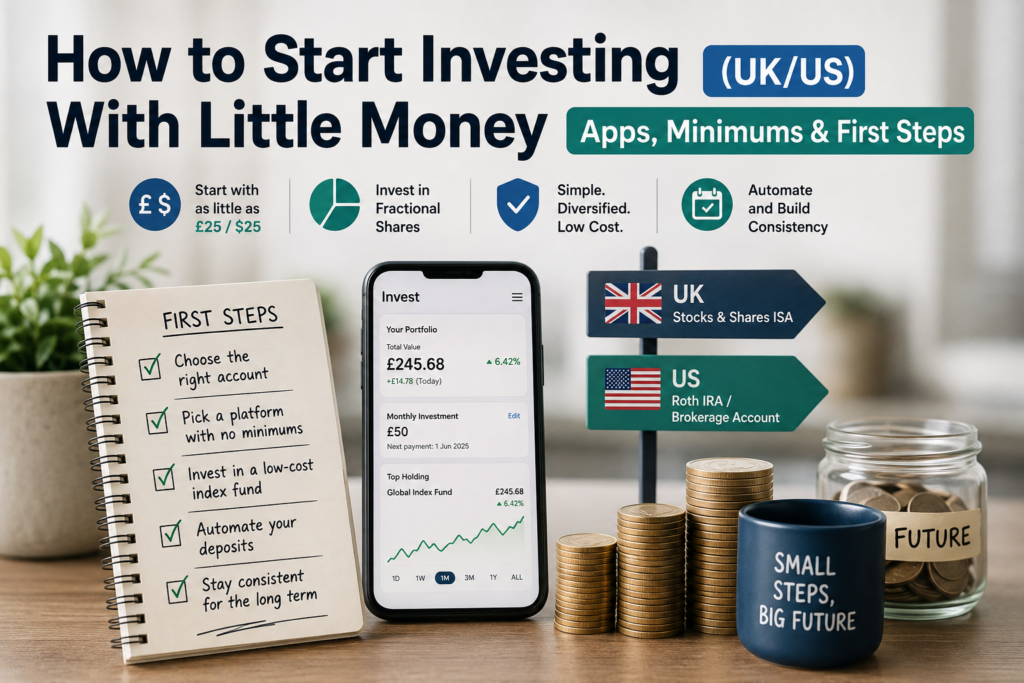
- Starting somewhere between £25 £100 (UK) or $25 $100 (US)
- Feeding in small, regular amounts rather than one dramatic lump sum
- Treating consistency as the priority, not the size of any single deposit
That might sound too small to matter. But run the numbers: $50 tucked away every month, growing at a typical long-run average of around 7%, can pass $60,000 over three decades. The habit of showing up does more heavy lifting than the size of the first cheque.
Step 1: Choose the Right Account Wrapper
Every plan to start investing with little money begins here. This is where the UK and US roads split.
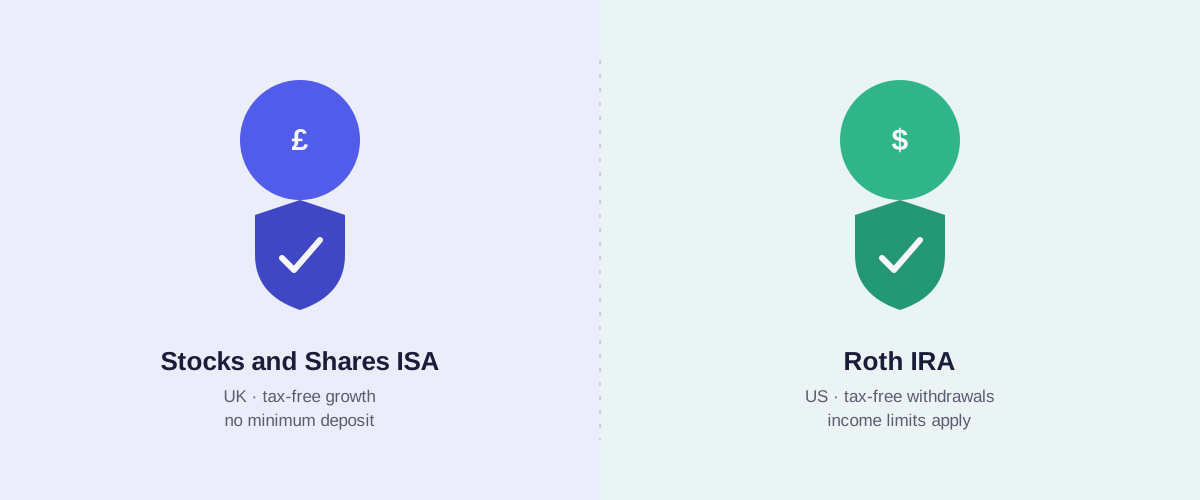
In the UK, the natural starting point is usually a Stocks and Shares ISA. Growth inside it sits outside the reach of Capital Gains Tax and Dividend Tax, and most providers will let you open one without demanding an opening deposit.
In the US, the closer equivalent is a Roth IRA, assuming you meet the income criteria contributions grow and can eventually be withdrawn tax-free in retirement. If you’d rather keep the money more accessible before retirement age, a plain taxable brokerage account does the job too.
Neither route forces a hefty opening balance. Most providers on both sides now let you open the account at £0 or $0 and fund it whenever you’re actually ready.
Step 2: Pick a Platform Built for Small Balances
The platform you choose can make or break your attempt to start investing with little money. Older-style brokers still charge a flat fee per trade, which quietly erodes a small contribution. Instead, look for platforms offering:
- No minimum balance requirement
- Fractional share purchases
- Little to no trading commission
- A built-in option to automate recurring deposits
UK investors often land on Trading 212, Freetrade, or InvestEngine for these reasons. In the US, Fidelity, Schwab, and Robinhood all support $1 fractional investing with no commission on most trades. This isn’t an endorsement of any one platform just a benchmark for what to compare when you’re shopping around.
Step 3: Keep the First Investment Simple
You don’t need to hand-pick individual companies to get moving, and most beginners are better off not trying. A single low-cost index fund or ETF tracking a broad market a total UK market fund, say, or a total US market fund spreads your money across hundreds of businesses in one purchase.
This matters even more with a small starting balance. Put £50 into one company and a single bad quarter can wipe out a chunk of it. Spread that same £50 across an index fund holding 500-plus companies, and no single company’s bad day sinks you.
Step 4: Automate It, Then Ignore It
The most common reason people stop investing has nothing to do with a market crash. It’s simply forgetting, or letting next month’s transfer quietly get spent on something else first. Set an automatic transfer for the day you get paid even if it’s only £20 or $20. This is sometimes called “paying yourself first,” and it takes willpower out of the equation entirely.
Where Small Investors Trip Up
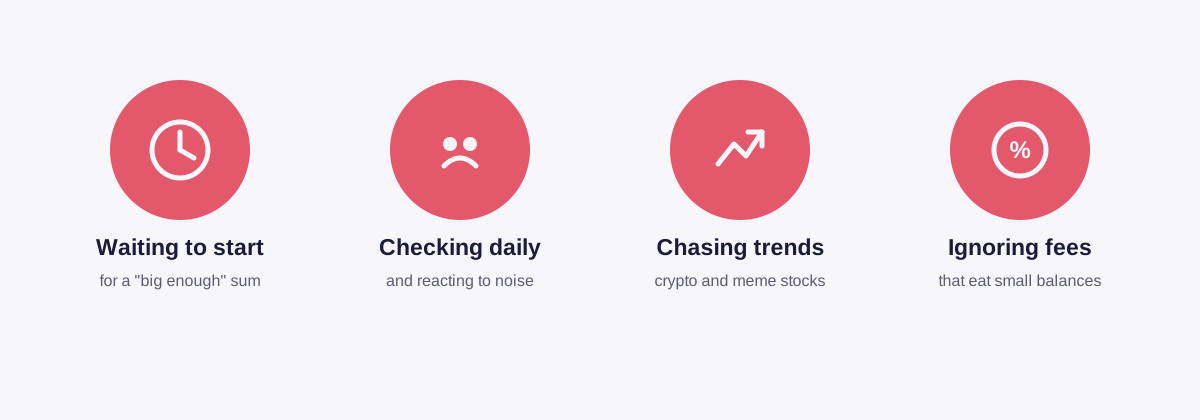
Waiting for the right amount. There’s no threshold where investing suddenly becomes worthwhile. £25 invested today has more runway to grow than £250 invested a year from now.
Refreshing your balance daily. A small portfolio moves in small absolute numbers, but the percentage swings can look alarming early on. Checking constantly adds anxiety without adding a single extra pound or dollar.
Chasing whatever’s trending. Crypto spikes, meme stocks, and “can’t-miss” tips are especially tempting when your balance is small and you want it to grow faster. The boring, diversified route wins more often once you look at long stretches of time.
Overlooking fees on a small balance. A 1% platform fee barely dents a large portfolio but takes a real bite out of a small one. Check the fee structure before committing, not after.
A Simple Starting Sequence
If you’re not sure where to begin, here’s a straightforward sequence to start investing with little money that works for both UK and US investors:
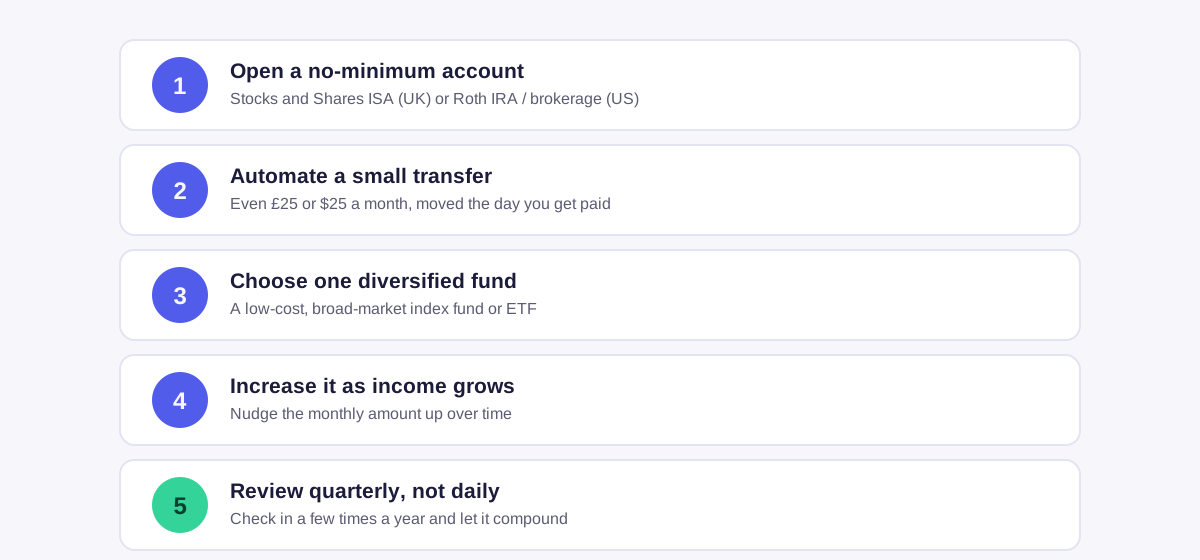
- Open a Stocks and Shares ISA (UK) or a Roth IRA/brokerage account (US) at a provider with no minimum deposit
- Set up an automatic monthly transfer for whatever you can genuinely spare even £25/$25
- Route it into one low-cost, broad-market index fund
- Nudge the amount up whenever your income does
- Step back and check in no more than once a quarter
Frequently Asked Questions
Can I actually start investing with little money like £25 or $25? Yes. Most major UK and US platforms now support fractional share purchases with no minimum balance, so a deposit that size can be invested the same day the account opens.
Should I invest a lump sum or drip-feed small amounts? For someone starting with limited money, regular small contributions sometimes called a recurring investment plan tend to serve better. It builds the habit, averages out your purchase price over time, and doesn’t require saving up before you begin.
Do I need a financial advisor to get started this small? Not really. A single low-cost, broad-market index fund is manageable to set up without one. An advisor earns their keep once things get more layered multiple accounts, a higher income, or specific tax questions.
What actually separates a Stocks and Shares ISA from a Roth IRA? Both shield your growth from certain taxes, but under different national systems. A Stocks and Shares ISA is a UK product with an annual allowance set by HMRC. A Roth IRA is a US product with its own contribution cap and income rules. Which one applies to you comes down to tax residency, not simply where you happen to live.
Does a small amount even move the needle? Not much over a few months, no. Stretched across 10, 20, or 30 years, small consistent contributions compound into something substantial. The habit does more work than the starting figure ever will.
Is investing a small amount still risky? All investing carries some risk, including the possibility of loss, regardless of the amount involved. Spreading a small contribution across a diversified index fund is generally viewed as lower-risk than betting it on one company.
Where This Leaves You
Learning how to start investing with little money isn’t a watered-down version of real investing it’s the same mechanism running at a smaller scale. Time in the market, consistency, and low fees do more for your outcome than the size of your opening deposit ever will. Whether that first £25 lands in London or that first $25 lands in Chicago, the underlying process doesn’t change, and starting earlier just gives it longer to work.
You don’t need a windfall to begin. You need an account with no minimum, one diversified fund, and a standing order you stop thinking about after month one. The rest tends to take care of itself and that’s the whole philosophy we build on here at ThePennyfy.
This article is for general informational purposes only and does not constitute financial advice. Investing involves risk, including the potential loss of your initial investment. Consider speaking with a qualified financial advisor before making investment decisions.