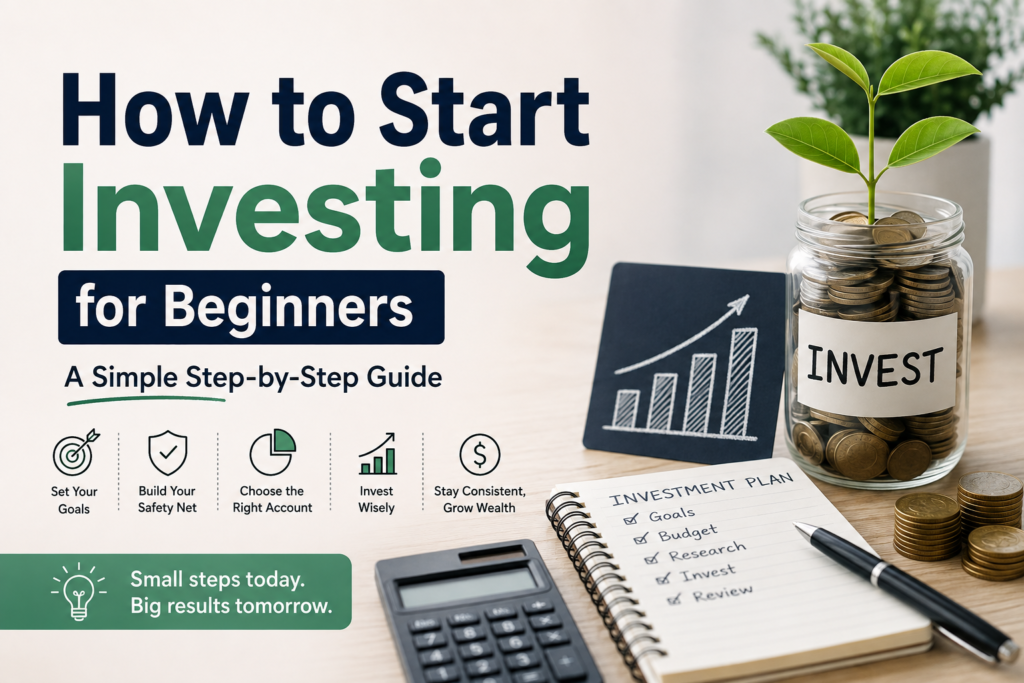

A friend of mine kept a chunk of savings in a regular bank account for six years, convinced she was “playing it safe.” When she finally worked out what that money would’ve been worth if she’d invested it instead, she wasn’t thrilled. That story sums up why so many people eventually go looking for how to start investing for beginners not because they want to gamble, but because they realise sitting still isn’t actually the safe option they thought it was. This guide, from the team at ThePennyfy, lays out the process in plain terms for readers in both the UK and the US.
What’s the Actual Point of Investing?
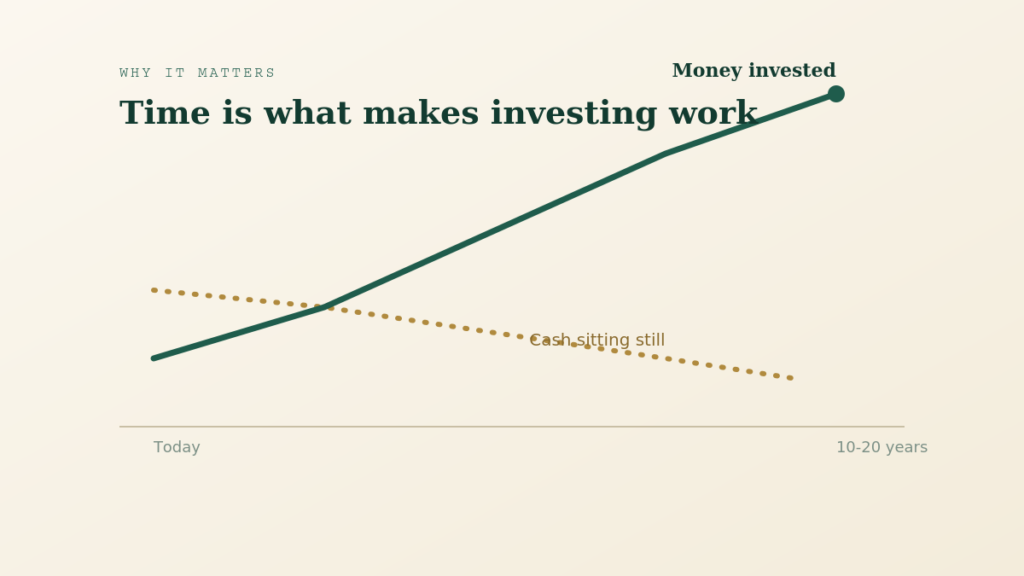
Here’s the part nobody explains well: money in a savings account doesn’t just grow slowly in real terms, it often shrinks. Prices rise year after year, and if your savings interest doesn’t keep pace, you’re quietly losing purchasing power without noticing. Investing is how you flip that equation. Your money starts working alongside inflation instead of falling behind it, and over enough years, compounding does the heavy lifting. A modest amount set aside monthly for fifteen or twenty years can genuinely change what your future looks like a paid-off mortgage sooner, a comfortable retirement, options instead of constraints.
How Much Cash Do You Actually Need?
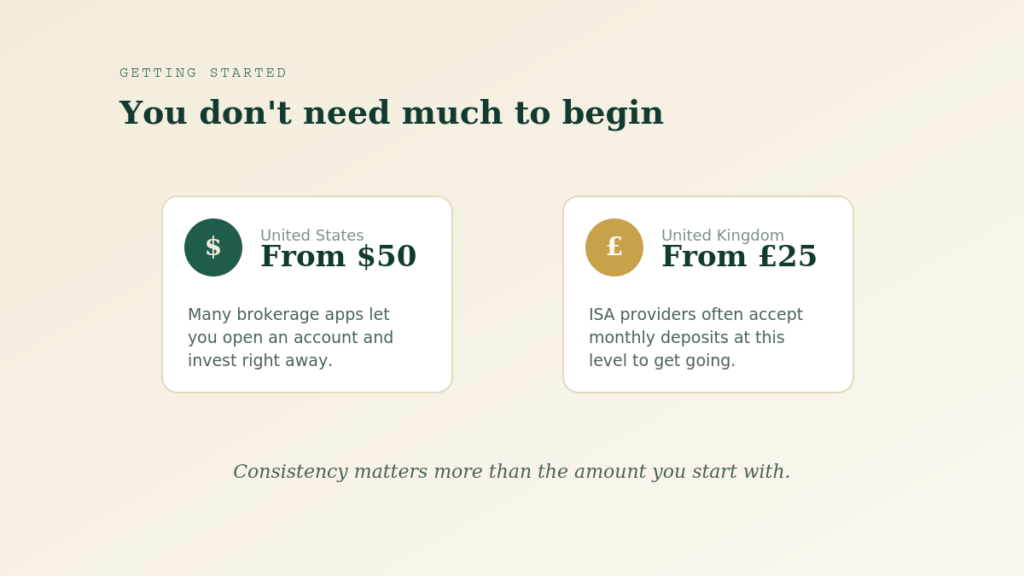
Less than most people assume investing, and that gap between perception and reality is exactly what stops so many from starting. Several US brokerage apps will open an account for you with $50 or under. UK-based ISA providers frequently accept £25 a month to get going. What separates people who build real wealth from people who don’t isn’t the size of that first deposit it’s whether they keep contributing month after month without fail.
Step 1: Nail Down Your “Why”
Before a single pound or dollar moves anywhere, work out what you’re actually saving for investing. A retirement thirty years out calls for a very different approach than a house deposit you want in three years. Write the goal down genuinely, on paper or in your notes app because it shapes every decision that follows: your risk tolerance, your account choice, and how long that money needs to stay untouched for investing.
Step 2: Build a Cushion Before You Invest a Penny
This is the step people are most tempted to skip, and it’s usually the one they regret skipping. Set aside three to six months of essential expenses somewhere accessible not invested, just parked safely. Skip this and a single unexpected bill a car repair, a boiler breaking down, a period without income can force you to cash out investments at the worst possible moment. Treat the emergency fund as the groundwork that makes everything after it more stable.
Step 3: Choose an Account That Matches Your Country
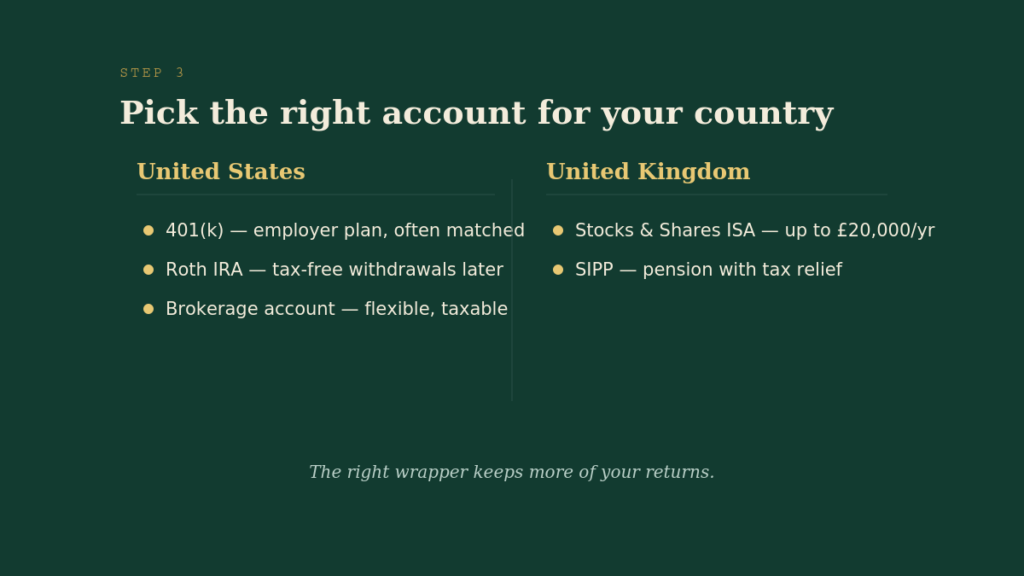
This is where the paths for UK and US readers genuinely diverge, since the tax rules and account types are completely different.
For Readers in the US
- 401(k): Offered through your employer if there’s a matching contribution attached, take full advantage, since turning it down means leaving free money behind.
- Roth IRA: Tax is paid upfront, which means every withdrawal you make in retirement is completely tax-free.
- Brokerage Account: No tax perks attached, but no real limits either a good option once you’ve made the most of tax-advantaged accounts.
For Readers in the UK
- Stocks and Shares ISA: Up to £20,000 can go in each tax year, and everything it earns growth, dividends stays outside the tax system entirely.
- SIPP: A pension wrapper that gives you tax relief on what you contribute, best suited to long-term retirement goals for investing.
Picking the right account isn’t a minor detail two people holding identical investments can end up with very different take-home returns purely based on which wrapper they used.
Step 4: Know What You’re Actually Putting Money Into
Stocks
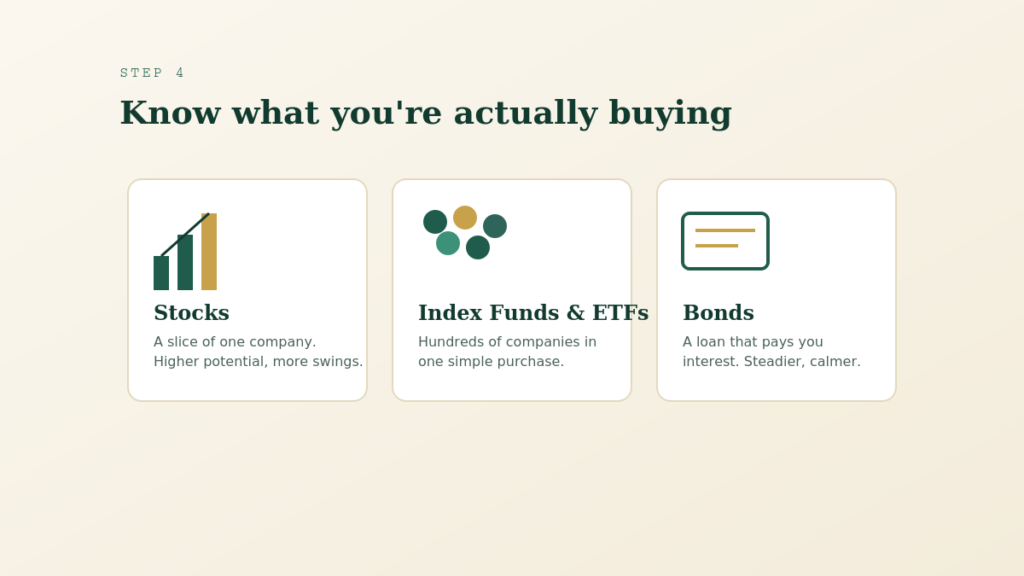
Owning a stock means owning a literal fraction of a company. Do well, and your slice grows with the business but individual stocks can swing sharply in the short run, sometimes with little obvious reason.
Index Funds and ETFs
Rather than betting on a single company, these spread your money across hundreds or thousands of companies in one purchase. An S&P 500 fund for US investors, or a global tracker fund for UK investors, delivers broad exposure without requiring you to pick winners yourself. For most beginners, this is genuinely the simplest entry point.
Bonds
A bond is essentially a loan you lend money to a government or company, they pay you interest in return. Returns are usually more modest than stocks, but bonds tend to soften the rougher patches in a portfolio.
Step 5: Set It on Autopilot
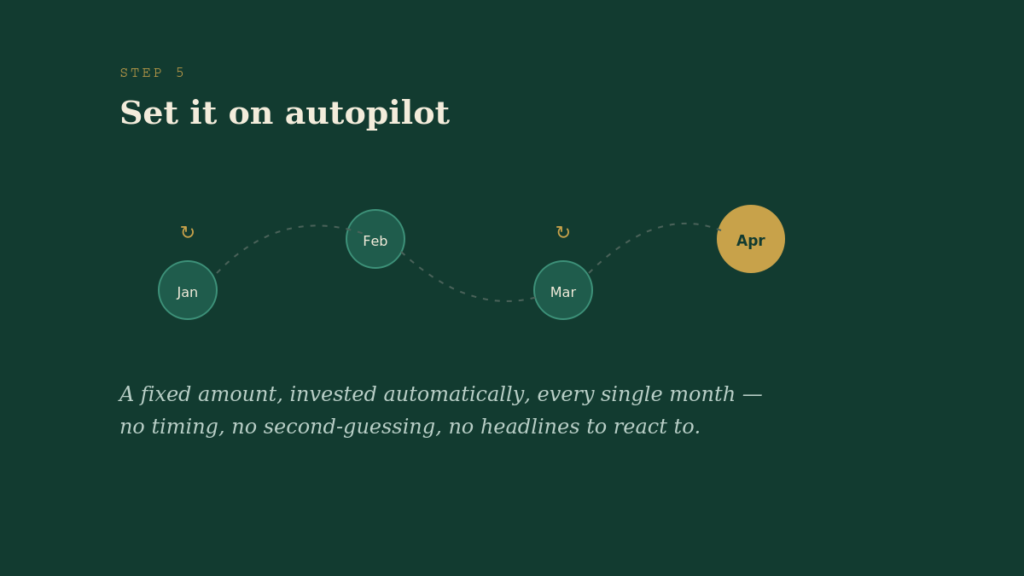
No one not analysts, not fund managers, no one can consistently predict where markets go next, so don’t waste energy trying. Set up an automatic monthly contribution and let it run regardless of what’s dominating the news that week. This method, often called pound-cost or dollar cost averaging, removes both the guesswork and the emotional decision-making from the process. Fifty pounds or fifty dollars, invested every month without fail, adds up to more than most people expect once a few years have passed.
Where Beginners Usually Go Wrong
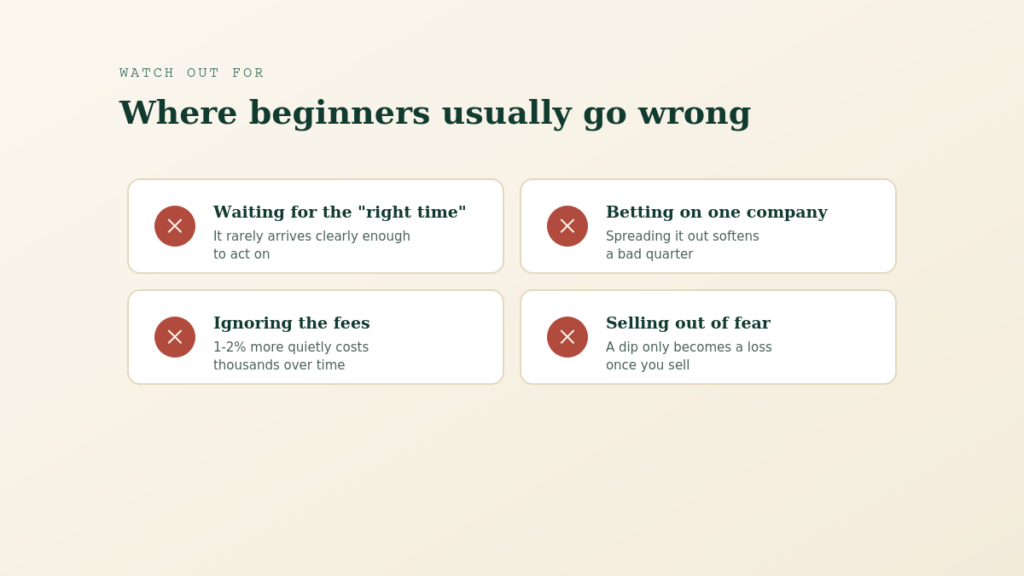
Beginners tend to fall into a handful of the same traps. Some hold out for what feels like the perfect moment to jump in except that moment rarely announces itself clearly, and plenty of people waiting for it are still sitting on the sidelines years later. Others put every pound or dollar into a single company because it feels exciting, when spreading that money across several holdings would mean one bad quarter from any one business doesn’t derail the whole plan. Fees are another blind spot a provider charging just 1-2% more than a rival barely registers day to day, yet it can quietly swallow thousands of pounds or dollars once a couple of decades have gone by. And then there’s timing: cash you’re likely to need in the next few years is generally better off sitting somewhere stable rather than riding out whatever the market decides to do next. One more habit worth watching for panic selling the moment prices dip. Markets go through rough patches regularly, and it’s usually the act of selling out of fear, not the dip itself, that turns a temporary drop into a real loss.
Frequently Asked Questions
What’s the simplest way to begin with a small amount of money? A low-cost index fund or ETF through an accessible platform a US brokerage app or a UK ISA provider both work well. Many accept starting deposits of $50 or £25.
Is there a minimum amount I actually need? Not really $50 or £25 is enough to get moving. Sticking with it consistently matters more than the size of that first deposit.
Could I lose money doing this? Yes, all investing carries some risk, but spreading money across diversified funds rather than individual stocks reduces that considerably. Staying invested over time tends to matter more than trying to catch the perfect entry point.
What actually separates an ISA from a 401(k)? An ISA (UK) is flexible and tax-free with no penalty for early withdrawal, while a 401(k) (US) is employer linked, often includes matched contributions, and penalizes withdrawals made before retirement age.
How soon will I notice a real difference? Realistically, five to ten years. Investing rewards patience far more consistently than it rewards trying to move quickly.
Final Thoughts
Strip away the jargon, and how to start investing for beginners really comes down to a handful of unglamorous habits: get clear on your goal, build a safety net first, choose the account that fits your country, understand what you’re buying, then automate it so discipline isn’t required every single month. None of this needs to start perfectly almost nobody’s does. At ThePennyfy, the message is simple an imperfect start today beats waiting indefinitely for a flawless plan. The real cost, more often than not, is the time spent hesitating.