


Quick answer: In the UK, you can’t set up a Direct Debit from a credit card. Direct Debits can only be taken from a bank or building society account. You can, however, pay many regular bills with a credit card by setting up a recurring card payment (also called a continuous payment authority) with the company instead. In the US, the “Direct Debit” system doesn’t exist in the same way. You simply add your credit card to a biller’s autopay.
That short answer hides some important details: which bills accept credit cards, what it costs, what protection you lose, and when it’s a bad idea. This guide covers all of it for UK and US readers.
Can You Pay Direct Debits With a Credit Card in the UK?
No. A Direct Debit is an instruction you give an organisation to collect money directly from your bank or building society account through the Bacs payment system. Credit cards aren’t part of that system, so there’s no way to point a Direct Debit mandate at one. You can read how the scheme works on the official Direct Debit website.
If a company says “we take monthly payments by card”, that isn’t a Direct Debit. It’s a recurring card payment, which works differently and has different rules (more on that below).
Direct Debit vs recurring card payment vs standing order

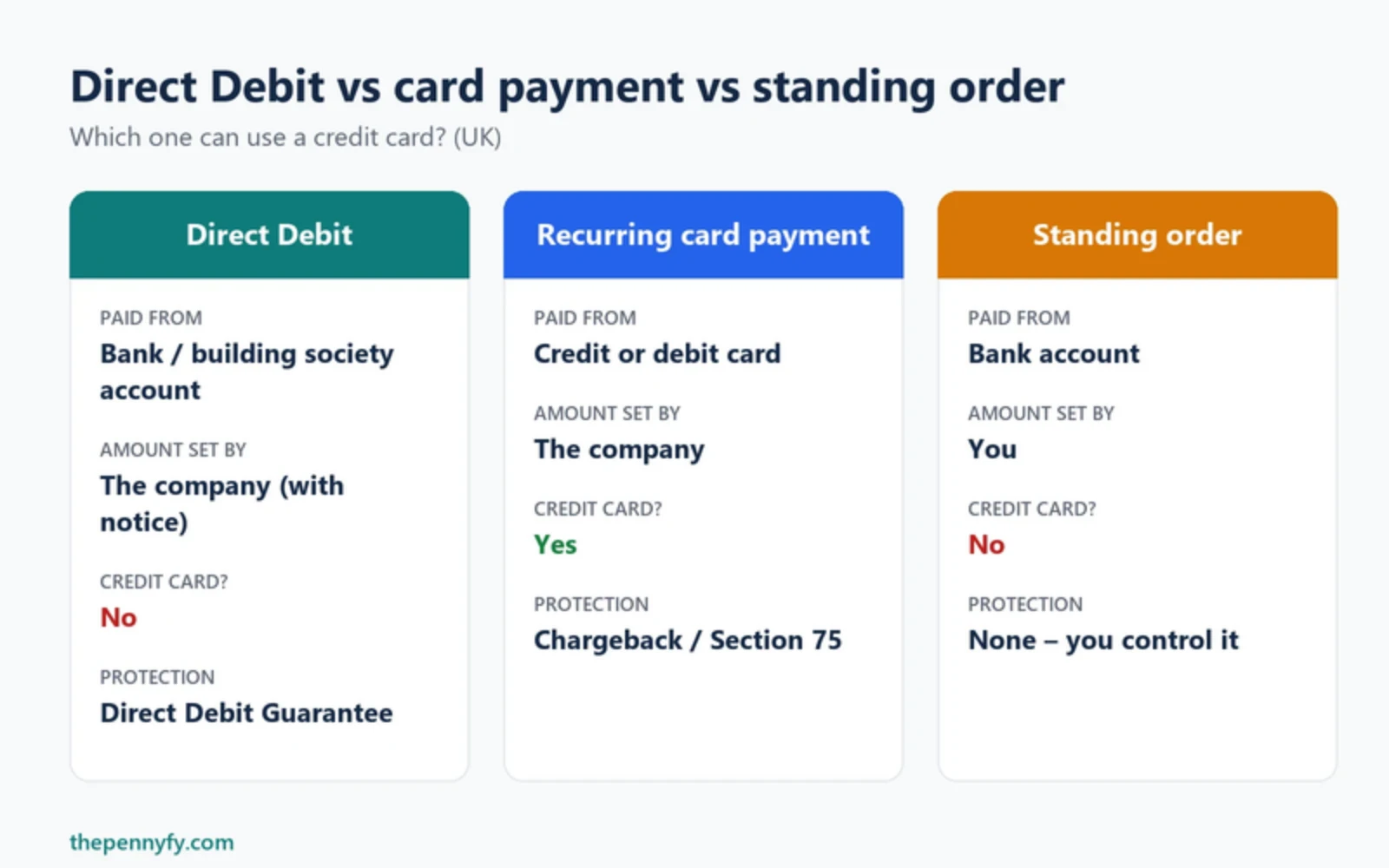
| Direct Debit | Recurring card payment (CPA) | Standing order | |
|---|---|---|---|
| Paid from | Bank/building society account | Credit or debit card | Bank account |
| Who controls the amount | The company (with notice) | The company | You |
| Works with a credit card? | ❌ No | ✅ Yes | ❌ No |
| Main protection | Direct Debit Guarantee | Chargeback / Section 75 | None (you set it up) |
| How to cancel | Your bank or the company | Your card provider or the company | Your bank |
How to Pay Regular Bills With a Credit Card (UK Step-by-Step)
If you want a bill to go on your credit card each month, here’s the usual process:

- Check the company accepts credit cards for recurring payments. Look in your online account under “payment methods”, or ask customer service. Many subscriptions, insurers, gyms, phone and broadband providers do.
- Cancel the existing Direct Debit only after the card payment is set up. Otherwise you could miss a payment and get a late fee.
- Add your credit card as the payment method and authorise ongoing payments.
- Check your first statement to make sure the payment arrived on the card and not your bank account.
- Pay off your credit card in full each month, ideally by setting up a Direct Debit from your bank to your credit card. That way you get the card benefits without paying interest.
Not sure how to set that last step up? See our guide on how to pay your credit card bill.
Which UK Bills Can (and Can’t) Go on a Credit Card?
Usually accept credit cards
- Streaming and software subscriptions (Netflix, Spotify, Microsoft 365)
- Mobile phone and broadband contracts (varies by provider)
- Car and home insurance paid annually. Paying the annual premium on a credit card can work out cheaper than paying monthly, because some insurers charge interest on monthly instalments. Compare both prices before you choose.
- Gym memberships and many online retailers
- Many councils for council tax. Check your local council via GOV.UK. See our guide to paying council tax by credit card.
Usually don’t accept credit cards
- HMRC tax bills: HMRC states you cannot pay by personal credit card.
- Mortgage payments: lenders normally collect these by Direct Debit, so check with yours before assuming a card will work.
- Loan repayments and other credit cards: lenders rarely let you repay debt with more borrowing. If you want to move a card balance, a balance transfer is the proper route. Our guide on paying off a credit card with a debit card explains the options.
- Rent: many landlords only take bank transfer or standing order.
Pros of Paying Bills With a Credit Card
- Section 75 protection (UK): for single purchases between £100 and £30,000, your card provider is jointly liable if something goes wrong. Citizens Advice explains how to claim.
- Rewards and cashback on spending you’d be doing anyway.
- An interest-free period on purchases with most UK cards, as long as you clear the full statement balance by the due date. Check your card’s terms for how long it lasts.
- Builds your credit history when you pay on time and keep your balance low. Track progress with a free credit score check.
- No surcharges: UK retailers have not been allowed to add a fee for paying with a personal credit card since January 2018.
Cons and Risks You Need to Know
- You lose the Direct Debit Guarantee. With a Direct Debit, you’re entitled to a full and immediate refund from your bank if an error is made. Card disputes (chargeback) can take longer.
- Interest can wipe out the benefit. If you don’t clear the card in full, you’ll pay credit card interest on your household bills, usually at a rate that quickly outweighs any rewards.
- Higher credit utilisation can temporarily lower your credit score. A commonly suggested guide is to keep your balance below about 30% of your limit. See our tips to raise your credit score.
- Cash-like payments are expensive. If a payment is treated as a cash advance, you’ll usually pay a fee (often a percentage of the amount) plus interest from day one.
- It’s easy to lose track. Recurring payments are easy to forget about, which is exactly how subscription costs creep up.
How to Cancel a Recurring Card Payment (UK)
You can cancel a recurring card payment by telling the company, or by contacting your card provider directly. The FCA explains that your card issuer must stop the payments, even if you haven’t contacted the business. Ask by the end of the business day before the next payment is due. Any payment taken after you’ve cancelled counts as unauthorised, and your card issuer must refund it and any related charges.

What About the US? Paying Bills With a Credit Card on Autopay
In the US, recurring bill payments usually run through ACH autopay from your checking account, the closest equivalent to a UK Direct Debit. The CFPB explains how automatic bank payments work. Unlike in the UK, though, many billers let you put a credit card on autopay just as easily.
US bills that commonly accept credit cards
- Utilities (electric, gas, water), sometimes with a “convenience fee”
- Cell phone, internet and streaming services
- Car and renters insurance
- Federal taxes, through IRS-approved payment processors. IRS-approved payment processors charge a fee, so check the current rate on IRS.gov before paying.
US bills that often don’t
- Mortgages: most servicers won’t accept credit cards directly
- Car loans and student loans: usually bank account only
- Rent: some landlords accept cards through online portals or third-party platforms, usually for a percentage fee.
Watch the fees: if a biller charges a 2 to 3% card fee, it will usually wipe out any 1 to 2% cashback you’d earn. In that case, pay from your bank account instead.
To stop a US autopay, cancel with the company and your card issuer. For bank-account autopays, the CFPB’s guide on stopping automatic payments walks you through it.
Should You Move Your Bills to a Credit Card?
It makes sense if all of these are true:
- You pay your credit card in full every month (ideally by Direct Debit or autopay)
- The company doesn’t charge a card fee
- You’ll earn rewards or want the extra purchase protection
- You track your spending with a budget. The 50/30/20 rule is a simple place to start.
It’s a bad idea if you already carry a balance, are paying interest, or are struggling with debt. In that case, focus on clearing what you owe first. Our comparison of debt snowball vs avalanche can help. If you’re in the UK and debts feel unmanageable, a debt management plan may be an option.
Frequently Asked Questions
Can I pay my Direct Debits with a credit card?
Not directly. UK Direct Debits can only come from a bank or building society account. Instead, ask the company to switch you to a recurring card payment on your credit card.
Can you set up a Direct Debit on a credit card?
You can set up a Direct Debit to pay off your credit card from your bank account (for the minimum, a fixed amount or the full balance). You can’t set up a Direct Debit that is paid from a credit card.
Is a recurring card payment the same as a Direct Debit?
No. A recurring card payment (continuous payment authority) is taken from your card. It isn’t covered by the Direct Debit Guarantee, but it can be protected by chargeback or, on credit cards, Section 75.
Does paying bills with a credit card hurt your credit score?
Not if you pay on time and keep your balance low. On-time payments can actually help. High balances or missed payments will hurt it. Going over your credit limit can also cost you, as explained in what happens if you go over your credit card limit.
Can I pay council tax with a credit card in the UK?
Some councils accept credit cards and some don’t. Check your council’s payment page.
Can I pay HMRC with a credit card?
No. HMRC doesn’t accept personal credit cards. You can pay by personal debit card for free, or use a corporate card for a fee.
Can you pay bills with a credit card in the US?
Yes. Many utilities, phone, insurance and subscription companies let you add a credit card to autopay, though some charge a convenience fee. Mortgages and most loans usually can’t be paid by card.
The Bottom Line
You can’t pay a Direct Debit with a credit card, but in the UK you can usually move the same bill to a recurring card payment. In the US, you can add your card to autopay. It’s worth doing only if there’s no fee and you clear your card in full every month. Otherwise, the interest will cost you far more than any rewards you earn.
This article is for general information only and isn’t financial advice. Rules and fees vary by provider, so always check with the company and your card issuer. Last reviewed October 2026.
Related reading: can you pay HMRC with a credit card


