
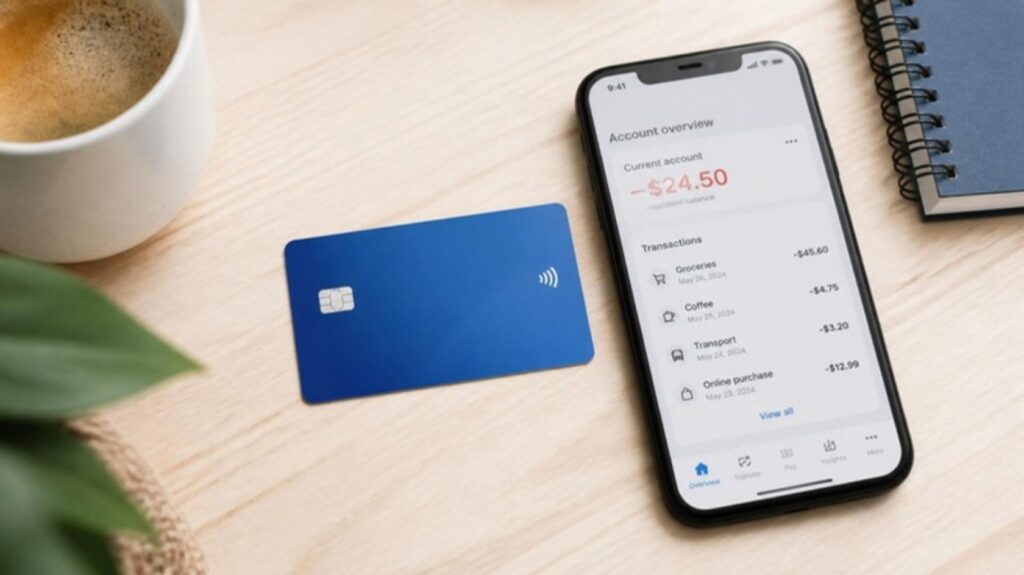

Yes. A debit card can leave your current account below zero, even though it is not a credit product. In the UK this usually happens through an arranged or unarranged overdraft, or when a payment such as a Direct Debit or a delayed card payment is taken after you have already spent the money. Any shortfall is money you owe your bank.
This guide starts with the UK rules, then covers the US, where overdraft fees work very differently. US readers can jump to the US section further down.
Can you go into debt with a debit card? The short answer
Yes, you can go into debt with a debit card. A debit card spends money from your current account (UK) or checking account (US). If a payment takes the balance below zero, the bank is in effect lending you the shortfall, and you will usually have to repay it. In the UK that normally means interest on an overdraft. In the US it usually means fees.
If your account has no overdraft and your bank refuses every payment you cannot afford, the risk is lower, but it is not zero. Direct Debits, delayed card payments and temporary holds can still take your balance below zero.
Four ways a debit card can leave you owing money
1. You use an overdraft
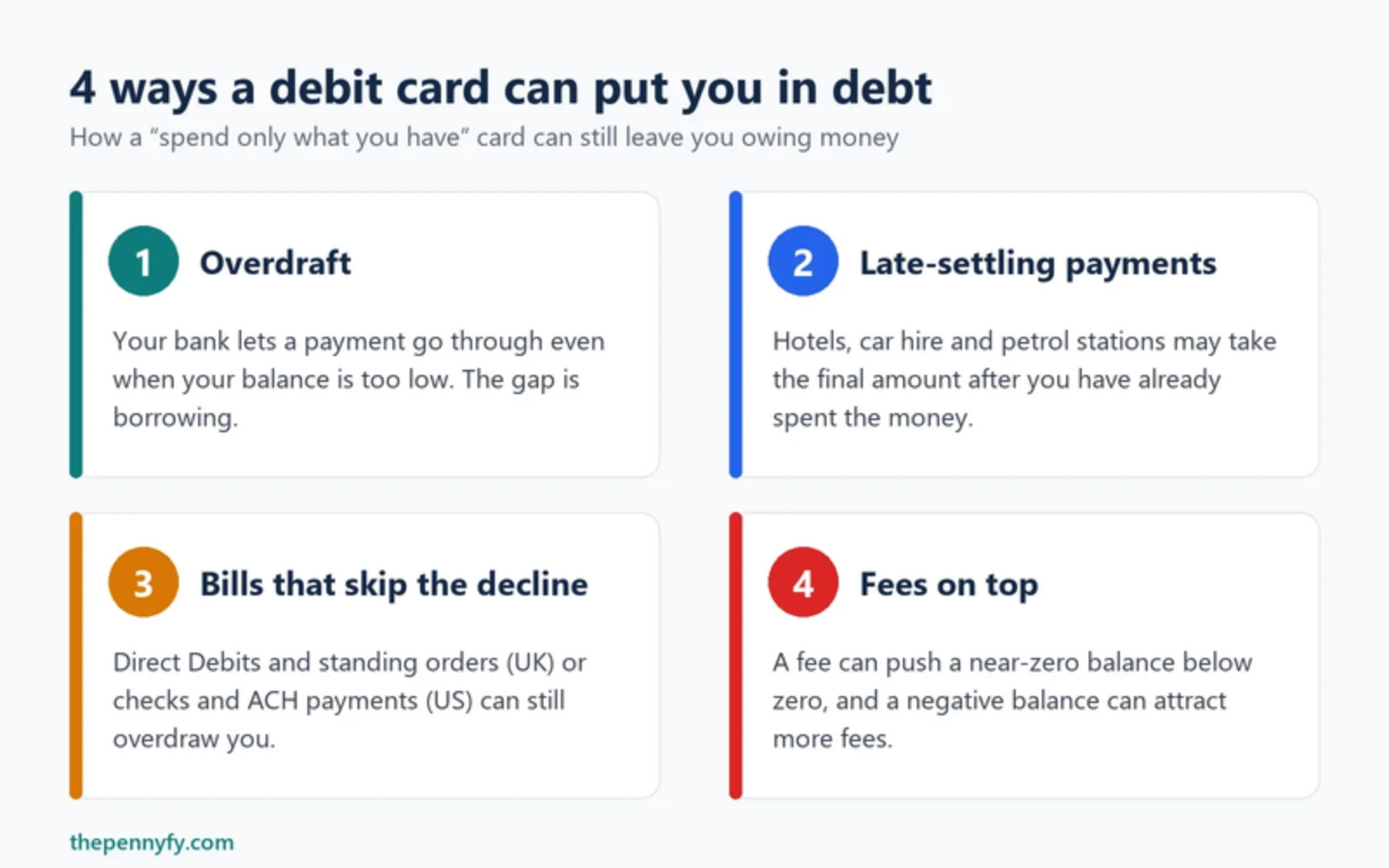
This is the most common route. If your account has an overdraft (UK) or overdraft coverage (US), your bank can let a debit card payment go through even when you don’t have enough money. The gap becomes borrowing.
2. A payment lands after you’ve spent the money
Hotels, car hire firms and some petrol stations reserve part of your available balance while they work out the final amount. At supermarket pay-at-pump, for example, Money Saving Expert reported in 2021 that £100 may be reserved if you have £100 or more available. The unused part is returned, usually within minutes, though some people reported waiting up to five days. Some card payments also take a day or two to settle.
If you check your balance, see money that looks available, and spend it before an earlier payment settles, you can end up below zero even though every payment was “approved”.
3. Some payments don’t get declined the way card purchases do
Card payments can be declined at the till. Other payments from the same account, such as Direct Debits and standing orders in the UK or checks and recurring ACH payments in the US, work differently. In the US, the CFPB notes that banks can charge overdraft fees on checks and recurring electronic payments even if you never opted in to debit card overdraft coverage.
For Direct Debits in the UK, your bank may refuse the payment, which can trigger a refused payment fee, or pay it, which can create an unarranged overdraft. The Direct Debit Guarantee covers mistakes, such as the wrong amount or date, but it does not cover a payment that clears correctly and leaves you short. Check your own bank’s terms for what it does.
4. Fees push the balance lower
In the US, a single overdraft fee can be larger than the purchase that caused it. If you’re already near zero, a fee alone can be what pushes the account negative, and a negative account can pick up more fees.
UK: debit cards and overdrafts
Arranged vs unarranged overdrafts
UK current accounts work with two kinds of overdraft:
- Arranged overdraft: a borrowing limit you’ve agreed with your bank in advance, for example £500. Using it is borrowing, and you pay interest on it.
- Unarranged overdraft: when you go below zero without an agreed limit, or beyond it. Banks usually try to refuse payments that would do this, but it can still happen, for example when a delayed card payment settles.
Some banks offer a small interest-free buffer, but the size varies by account, so check your own terms rather than assuming you have one.
What it costs since the 2020 FCA rules
Overdraft pricing in the UK changed completely on 6 April 2020. Under rules announced by the Financial Conduct Authority, banks and building societies must:
- charge for overdrafts with a single, simple annual interest rate
- not charge fixed fees for borrowing through an overdraft, so there are no daily or monthly overdraft fees
- not charge more for unarranged overdrafts than for arranged ones
- advertise arranged overdraft prices with an APR
The ban on fixed overdraft fees does not stop banks charging a fee when they refuse a payment you cannot cover. The FCA’s guidance says these fees should reasonably reflect what it costs the bank to refuse the payment.
This made unarranged overdrafts cheaper than before, but overdraft interest can still be high. When the FCA compared costs around the 2020 changes, its figures for Lloyds Banking Group accounts used a representative 39.9% APR. That was a 2020 figure for those brands. Your own bank’s rate may be different, so check your account terms.
Worked example (illustrative, using the 2020 rate above): if you’re £200 overdrawn for 30 days at 39.9% a year, the interest works out at roughly £6.56 (200 × 39.9% × 30/365, before compounding). That is modest for a short period, but it adds up if you stay in your overdraft month after month. Your bank’s actual rate may be higher or lower, so check your account’s rate before relying on this.
Will it show on your credit file?
Yes. In the UK, current accounts with overdrafts are reported to credit reference agencies. Experian explains that an overdraft appears on your credit report as a debt. Experian says that using an arranged overdraft sensibly, staying within your limit and without payments being refused, usually has little effect, while regular use of an unarranged overdraft can hurt your credit rating.
Experian also notes a quirk: most banks report to the agencies about once a month, so a brief dip that you clear before that snapshot may not show up at all.
Already overdrawn in the UK? What to do next
- Contact your bank early. Citizens Advice says that if you cannot repay your overdraft, the bank may agree to pause interest or fees, or let you pay essential costs such as food and bills first. The FCA has also told banks to identify customers who show signs of financial strain and to have a strategy to reduce repeat overdraft use.
- Check what you owe and what is being charged. Look at your account terms and your latest statement. If this is unusual for you, ask whether any charges can be refunded. Banks may or may not agree, so ask politely and keep a note of the reply.
- Know what a default notice means. A default notice is a letter saying you need to repay or your account will be closed. You may still be able to agree a repayment plan.
- Get free advice. Citizens Advice and GOV.UK’s guide to options for dealing with your debts are good places to start. If your bank does not help, you can complain to it and then to the Financial Ombudsman Service, within 6 months of the bank’s reply.
- Do not take on new expensive borrowing in a hurry. Citizens Advice warns that a loan to clear an overdraft may cost more.
- US readers: the CFPB explains what to do about overdraft fees.
- If you’re juggling several debts, our guide to the debt snowball vs avalanche methods can help you decide what to pay off first.
How to make your debit card (almost) debt-proof

- Check whether you have an overdraft or overdraft coverage. UK: look in your banking app for an “arranged overdraft limit”. US: ask your bank whether you’re opted in to debit card overdraft coverage.
- Remove or reduce it if you don’t need it. UK banks will usually let you reduce your arranged limit to £0. US customers can cancel debit overdraft coverage at any time, and the CFPB’s guide to avoiding debit card overdrafts lists the options.
- Turn on low-balance alerts in your banking app so you hear about a problem before it becomes a fee. If checking your balance makes you anxious, our guide to budgeting when you’re too stressed to check your bank account may help.
- Budget around pending payments, not the headline balance. Leave a small cushion for holds and payments that haven’t landed yet.
- Line up bill dates with payday. Moving Direct Debits (UK) or autopays (US) to just after you’re paid removes the most common cause of accidental overdrafts. Our guide to budgeting on a bi-weekly paycheck shows how to map this out.
- Link a savings account (US) if your bank offers overdraft transfers. It’s usually cheaper than a standard overdraft fee.
US: overdraft coverage and negative balances
The opt-in rule
Under federal rules (Regulation E), your bank can’t charge you an overdraft fee on ATM withdrawals or one-time debit card purchases unless you’ve opted in to overdraft coverage. If you haven’t opted in, those transactions should simply be declined.
Opting in doesn’t guarantee coverage either. The CFPB confirms that your bank can still decline a purchase even if you’ve opted in. You’re only giving it permission to charge a fee when it does pay.
The catch, as mentioned above, is that the opt-in rule only covers ATM and one-time debit card transactions. Checks and recurring payments can still overdraw your account and trigger fees.
What a negative balance can cost
US banks usually charge a flat fee per overdrawn item rather than interest, so costs add up quickly with small purchases.
Worked example (illustrative): say your bank charges $35 per overdraft and you’re $10 short. You buy a $6 coffee, a $12 lunch and a $9 app subscription. That could mean three overdraft fees ($105) for $27 of spending. Fee amounts and policies differ between banks, so check your own account’s fee schedule rather than relying on this example.
A 2025 change matters here too. The CFPB finalised a rule in December 2024 that would have capped overdraft fees at large banks at $5 (or at cost). Congress repealed it, and it was signed into law in May 2025, according to the Congressional Research Service. There is no federal cap on overdraft fees, so fees depend on your bank’s own policy. Older articles that describe the cap as coming soon are out of date.
Credit reports, ChexSystems and collections
Checking accounts don’t normally appear on your credit reports from Experian, Equifax or TransUnion, so a short overdraft you repay won’t hurt your score. The risk comes if you don’t repay it. According to the CFPB:
- a bank can close an account with an unpaid negative balance and report it to a checking account reporting company such as ChexSystems, which can make it harder to open a new account
- the unpaid balance can be passed to a debt collector, and a collection account can appear on your credit reports and damage your score
UK vs US at a glance
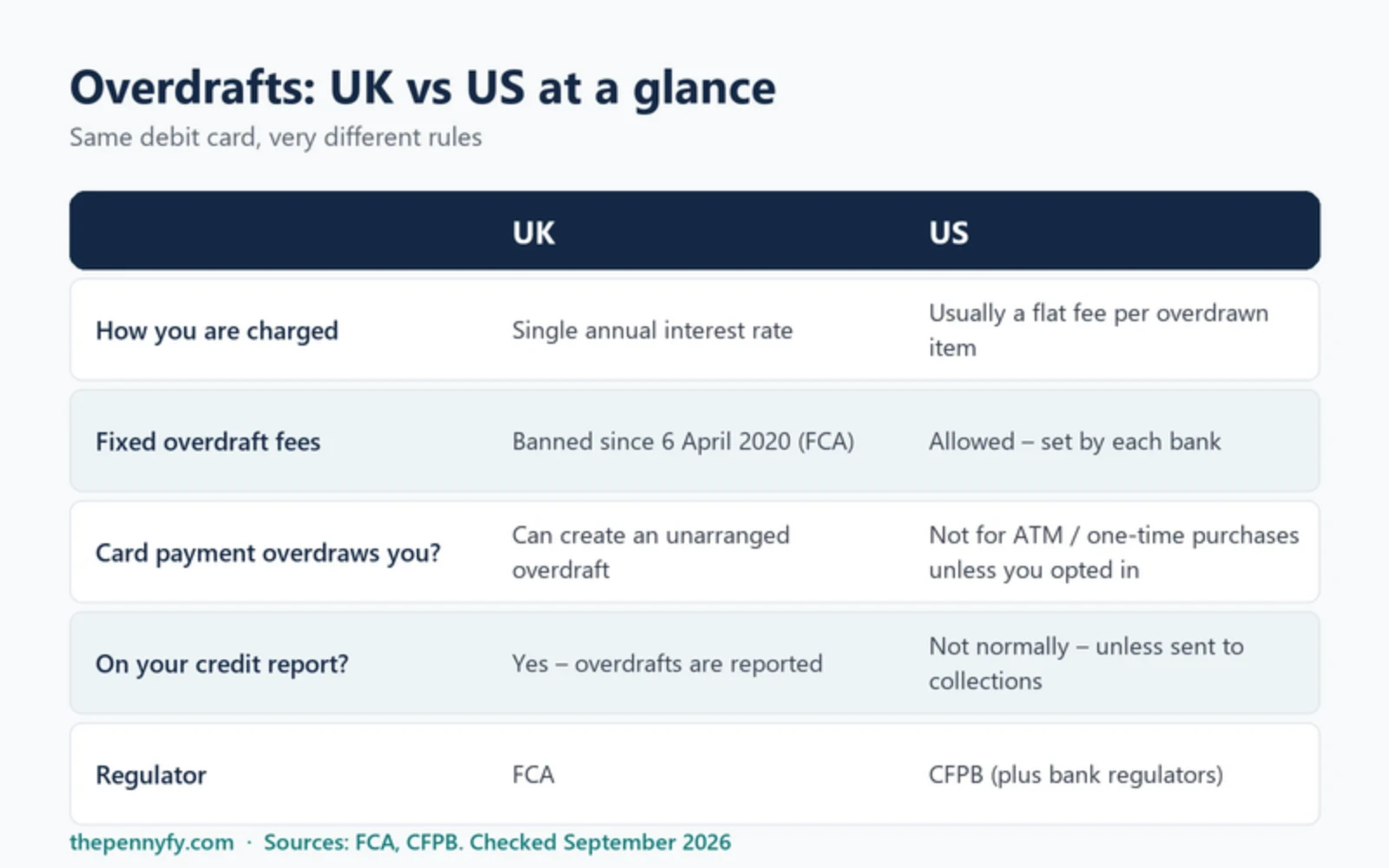
| UK | US | |
|---|---|---|
| Account name | Current account | Checking account |
| How overdrafts are charged | Single annual interest rate. Fixed overdraft fees banned since April 2020 | Usually a flat fee per overdrawn item |
| Can the bank let a card payment overdraw you without your agreement? | It may create an unarranged overdraft, priced no higher than arranged | Not for ATM or one-time debit purchases unless you opted in |
| Shows on credit report? | Yes, overdraft balances are reported to credit reference agencies | Not normally, unless an unpaid balance goes to collections |
| Main regulator | FCA | CFPB (plus bank regulators) |
Is debit card debt worse than credit card debt?
It depends on the country and how long you owe the money.
In the US, a flat overdraft fee on a small purchase can make overdraft borrowing far more expensive than a credit card for the same amount. In the UK, overdraft rates are high but charged as interest, so a short, small overdraft can cost less than you’d expect, while a long-term one adds up.
Credit cards also offer protections debit cards don’t have, such as Section 75 in the UK. If you’re weighing the two, our comparison of credit cards vs debit cards goes through the pros and cons in detail. Going over a credit card limit has its own costs, covered in what happens if you go over your credit card limit.
If you are in the US and wondering whether pressing “credit” at the till changes anything, read can you use a debit card as a credit card.
Frequently asked questions
Can a debit card go negative?
Yes. The card does not hold money. Your current or checking account does, and it can go below zero through an overdraft, a payment that settles late, a Direct Debit or fees.
What happens if you overdraft your debit card?
In the UK, an arranged overdraft is borrowing at your bank’s overdraft rate. If you go beyond your limit, or have no overdraft, the bank may refuse the payment, and a refused payment fee can apply. If it lets the payment through, you owe the shortfall, priced no higher than an arranged overdraft. In the US, a bank that has your opt-in may pay a debit purchase and charge a fee, and it can still decline.
Will my debit card be declined if I do not have enough money?
Often, yes, but not always. In the US, without opt-in, ATM and one-time debit purchases should be declined. In the UK, banks may refuse payments beyond your limit. Direct Debits, checks and recurring payments can behave differently.
Does going overdrawn affect my credit score?
UK: overdrafts appear on your credit file. Staying within an arranged limit usually has little effect, while regular unarranged use can hurt. US: checking accounts do not normally appear on credit reports, but an unpaid negative balance can lead to collections.
What happens if I never pay back a negative balance?
UK: the bank may send a default notice, close the account and take further action, including court action if you do not pay or agree a plan. US: the bank may close the account, report it to a checking account reporting company such as ChexSystems and pass the debt to a collector.
Does using a debit card build credit?
No. Debit card spending uses your own money and is not credit, so it does not build a credit history. To build a credit history you need a credit product used responsibly. See our tips to raise your credit score.
Are overdraft fees banned in the UK?
Fixed overdraft fees, such as daily or monthly charges for using an overdraft, were banned from 6 April 2020, and banks now use a single annual interest rate. A fee for refusing a payment can still apply.
Is there a limit on US overdraft fees?
There is no federal cap. The CFPB’s $5 cap rule for large banks was repealed in 2025, so fees depend on your bank’s policy.
The bottom line
A debit card is safer than a credit card for avoiding debt, but it isn’t foolproof. You can go into debt with a debit card through an overdraft, a payment that settles late or fees that land when you’re near zero. UK readers should watch overdraft interest and their credit file. US readers should check their overdraft opt-in and watch per-item fees.
Take five minutes today to check your overdraft settings and switch on balance alerts. That’s usually enough to make sure “debit” really does mean spending only the money you have.
This article is general information, not personal financial advice. Bank fees, rates and policies vary, so check your own account terms. Last reviewed October 2026.
Update, 13 October 2026: we rewrote the opening, added a UK section on what to do if you are already overdrawn, removed an unsupported comparison with credit card costs, and changed the wording about what UK banks must do about repeat overdraft use so that it matches the FCA press release linked in the sources below.
Related reading: paying Direct Debits with a credit card
Sources and further reading
- FCA: FCA confirms biggest shake-up of the overdraft market (press release, 7 June 2019)
- FCA: Changes to overdraft charges (data page, last updated 12 October 2020)
- Experian: Overdrafts and your credit score
- Citizens Advice: If you’re struggling with your overdraft
- Direct Debit: Direct Debit Guarantee
- Money Saving Expert: Card providers to reserve up to £100 when you pay at many self-service fuel pumps (27 July 2021)
- CFPB: Regulation E, section 1005.17
- CFPB: If I opted into debit overdraft coverage, can the bank still decline a debit purchase?
- CFPB: Will it hurt my credit if my bank or credit union closed my checking account?
- CFPB: How can I avoid debit card overdrafts?
- CFPB: What can I do if my bank charged me a fee for overdrawing my account?
- Congressional Research Service: Congress Repeals CFPB’s Overdraft Rule
- GOV.UK: Options for dealing with your debts