

Posted in Credit & Debt | The Pennyfy Posted by Ethan Carter
A few years ago, before I learned how to check credit score for free in the UK and US, I applied for a car loan and got turned down flat. No warning, no explanation beyond a generic letter saying my “credit profile didn’t meet the lender’s criteria.”
That one afternoon of checking cost me nothing maybe fifteen minutes, tops. The rejected car loan application, on the other hand, cost me a noticeably worse interest rate on the loan I eventually did get approved for a few months later, once I’d sorted the mess out.
If you’ve never actually looked at your credit score, or you check it once a year and forget about it, this guide shows you how to check credit score for free whether you’re in the UK or the US and what to actually do with the number once you have it.
Why Your Credit Score Matters More Than You Think
Your credit score isn’t just a number that shows up when you apply for a credit card. It quietly affects:
- The interest rate you’re offered on loans, mortgages, and credit cards
- Whether you get approved for a phone contract or need to pay a deposit
- Some landlords’ decisions on rental applications
- Car insurance premiums in parts of the US
- Whether a mainstream lender will touch you at all, or whether you’re pushed toward high-interest “bad credit” products
The frustrating part is that most people only think about their credit score right before they need it when they’re already halfway through a mortgage or car finance application. By then, if there’s an error on your report or the number’s lower than you expected, it’s usually too late to do anything about it before the decision gets made.
Checking regularly, even just once every few months, means you catch problems while you still have time to fix them instead of finding out the hard way, like I did.
How to Check Your Credit Score for Free in the UK
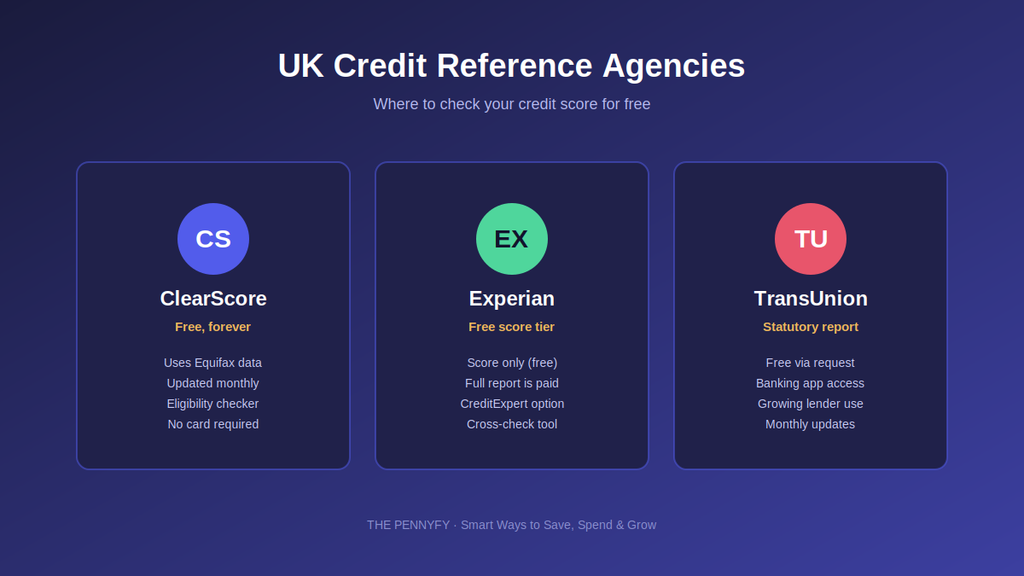
In the UK, three credit reference agencies hold your data: Experian, Equifax, and TransUnion. Here’s the part most people don’t realise each one can show a slightly different score, because they don’t all hold identical information and each uses its own scoring model. That’s exactly why relying on just one isn’t enough if you want the full picture.
1. ClearScore (Equifax data)
This is the one I actually use, and honestly the one I’d point most UK readers toward first. ClearScore has built its whole reputation on being free, permanently, with no trial period that quietly turns into a paid subscription three months in. It pulls your credit score and full report from Equifax, updates it monthly, and sends you alerts if anything changes on your file. You’ll also get an eligibility checker that estimates your odds of approval for specific credit cards or loans before you actually apply, which saves you from a hard search hitting your file unnecessarily something I wish I’d known about before that car loan application.
2. Experian’s Free Score
Experian offers a free version of your score, though it’s more limited than what you’d get through their paid CreditExpert service. Still, it’s worth having alongside ClearScore since Experian’s data doesn’t always match Equifax’s exactly.
3. TransUnion
You can access your TransUnion data for free through your statutory credit report or through several UK banking apps that now partner with TransUnion to show your score directly in-app.
4. Your Statutory Credit Report
Here’s something a lot of guides gloss over: under UK data protection law, every credit reference agency is legally required to give you your statutory credit report for free if you request it directly, not just a summarised score through an app. It’s not going to win any design awards it usually shows up as a fairly plain PDF or a bare-bones web page but it’s the rawest, most complete version of your data, and it costs nothing.
Practical approach: The easiest way to check credit score for free in the UK is to sign up for ClearScore and Experian’s free score (both take a few minutes), then check your full statutory report once a year to catch anything the apps might present differently.
How to Check Your Credit Score for Free in the US
In the US, the equivalent three agencies are Equifax, Experian, and TransUnion. The system works a little differently to the UK, but the underlying idea is the same: multiple agencies, multiple scores, and it’s worth checking more than one source.
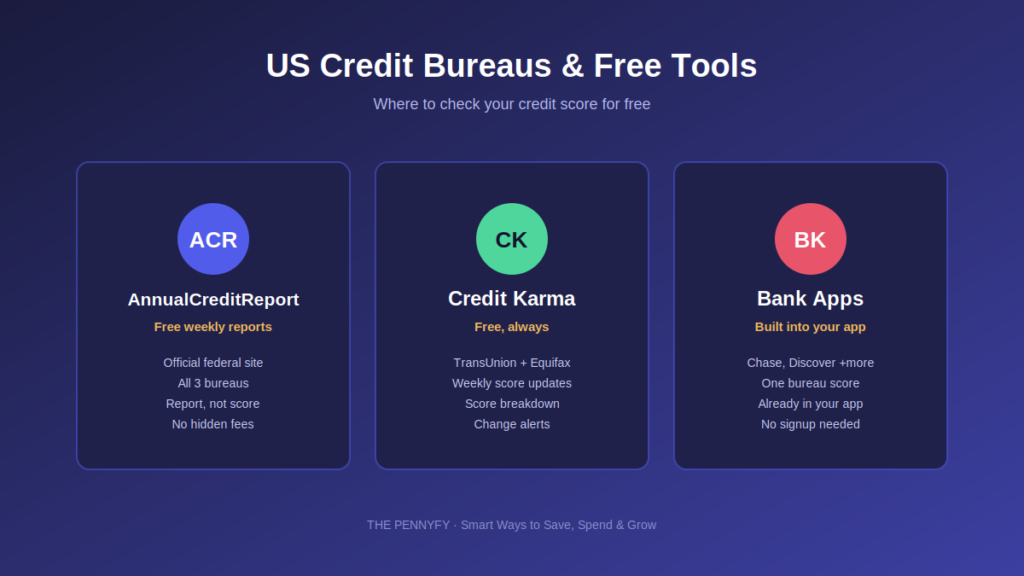
1. AnnualCreditReport.com
This is the official site jointly run by all three major credit bureaus, and it exists specifically because federal law requires it. Despite the name suggesting you can only use it once a year, that hasn’t been true since the pandemic-era program was made permanent: you’re now entitled to a free credit report from each bureau every single week if you want it. This is the most reliable, no-catch source for your actual credit report data not a score, but the underlying report your score is calculated from.
2. Credit Karma
Credit Karma gives you free weekly access to your TransUnion and Equifax scores and full reports, along with a breakdown of exactly what’s helping or hurting your score credit utilisation, payment history, account age, and so on. It’s genuinely free, funded by product recommendations rather than subscription fees. A friend of mine in Chicago uses it mainly to watch her score creep up month over month after paying down a credit card she says seeing the number move is oddly motivating, more than any budgeting spreadsheet ever was.
3. Your Bank or Credit Card Provider
Many US banks and credit card issuers Chase and Discover among them now show your credit score for free directly in their app, usually pulled from one of the three bureaus. It’s easy to miss because it’s often buried a couple of menus deep, so if you already have a card or account with a major provider, it’s worth digging around in the app before signing up for anything new.
4. Experian’s Free Membership
Experian also offers a free tier in the US that gives you your Experian score and some report details, which is useful to cross-reference against what Credit Karma shows for TransUnion and Equifax.
Practical approach: Use Credit Karma for weekly tracking, and pull your full report from AnnualCreditReport.com periodically to check everything Credit Karma might not surface.
What Counts as a Good Score When You Check Credit Score for Free?
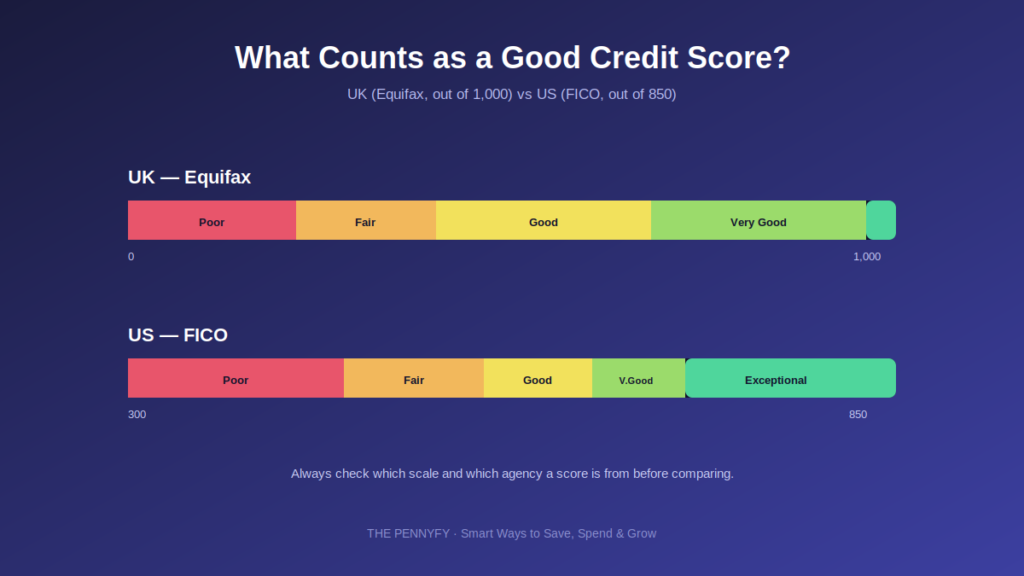
This trips a lot of people up because the UK and US use completely different scales, and even within each country, different agencies use different ranges.
UK (Equifax, out of 1,000):
- 0–438: Poor
- 439–530: Fair
- 531–670: Good
- 671–810: Very Good
- 811–1,000: Excellent
US (FICO, out of 850):
- 300–579: Poor
- 580–669: Fair
- 670–739: Good
- 740–799: Very Good
- 800–850: Exceptional
Don’t panic if the number looks low compared to a score you saw quoted somewhere else I did exactly this once, comparing my Equifax number to a friend’s FICO score and briefly convinced myself mine was terrible, before realising we weren’t even looking at the same scale. Always check which scale and which agency it’s from before comparing.
What to Actually Do Once You’ve Checked
Checking your score is the easy part. Here’s what actually moves the number:
Look for errors first. An account you don’t recognise, a payment marked late that you’re sure you made on time, or an old address still showing as current can all drag your score down unnecessarily. This was basically my whole problem with that car loan one wrongly recorded missed payment and one account I’d never opened. Every agency has a formal dispute process, and correcting a genuine error can improve your score faster than almost anything else on this list.
Pay on time, every time. Payment history is the single biggest factor in most scoring models. Setting up direct debits (UK) or autopay (US) for at least the minimum payment removes the risk of a late payment simply slipping your mind.
Keep your credit utilisation low. This is the percentage of your available credit you’re actually using. Staying under 30% and ideally lower signals to lenders that you’re not overly reliant on credit.
Don’t apply for multiple products in a short window. Each hard credit check can knock a few points off your score temporarily, and several in a short period can look like financial distress to a lender, even if that’s not what’s happening.
Leave old accounts open. The length of your credit history matters, so closing your oldest credit card even if you don’t use it much can shorten your average account age and lower your score.
How Often Should You Actually Check?
You don’t need to check daily, and doing so won’t hurt your score (checking your own score is a “soft” check and has zero impact). A quarterly check is a reasonable habit for most people, with a more detailed look before any major application a mortgage, a car loan, or a new credit card.
Final Thoughts
Your credit score isn’t something to check once and forget about, but it also doesn’t need to become an obsession. A quick quarterly check, using one of the free tools above, is enough to catch problems early and understand roughly where you stand before you need to rely on that number for something important.
If you found this useful, take five minutes today and actually check credit score for free using one of the tools above whether that’s ClearScore in the UK or Credit Karma in the US whether that’s ClearScore in the UK or Credit Karma in the US. It genuinely takes less time than making a cup of tea, and future-you, sitting in a lender’s office, will thank present-you for it.
Related reading on The Pennyfy: How Much Does a Debt Management Plan Cost in the UK?, How to Create a Financial Plan for Beginners: 7 Simple Steps